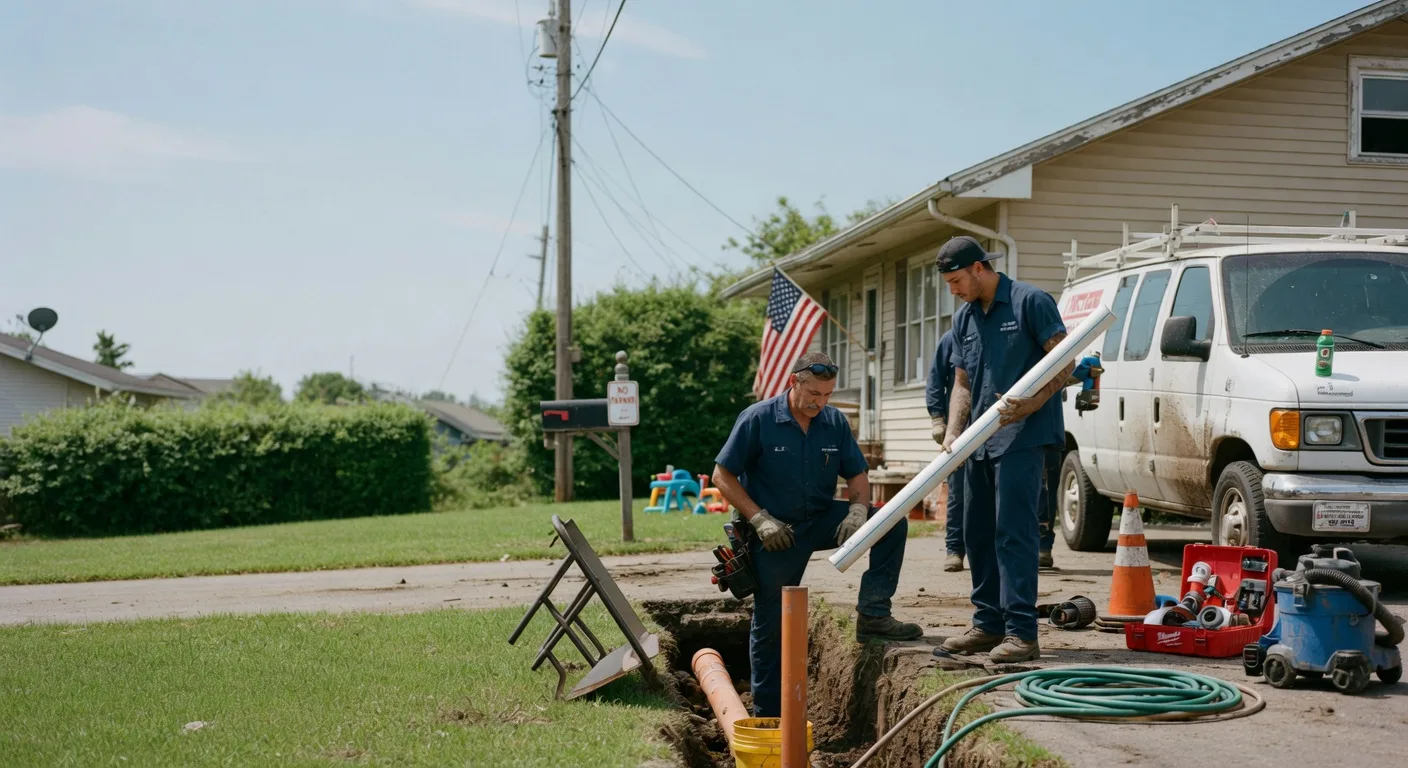
Why does the same drain keep clogging again just days after it was cleared?
A clog that returns within days almost always means one of two things. Either the first cleaning opened a path without removing the whole blockage, or the real cause was never touched. A cable machine punches a channel through the middle of a clog. That restores flow, but it can leave a ring of grease, scale, or packed debris clinging to the pipe wall, and that ring catches the next load of waste quickly. Underneath that sit the causes a cable cannot fix: roots growing in at a clay joint, a bellied section holding standing water, a cracked or offset joint catching paper, or rough scale in cast iron. Start by noting whether it is one fixture or several. A single kitchen or bathroom line that refills fast often needs hydro jetting, which scours the full width of the pipe wall rather than opening a hole through the center. A repeat clog in the main, or several fixtures slowing together, needs a camera inspection, because it shows the pipe's condition instead of just clearing it again. Chemical cleaner between visits usually makes things worse for the next tool. Expert Plumbers Co connects homeowners in Apple Grove, WV with an independent local plumber who can find out why the drain will not stay clear. Access to the line and how much of it must be opened up are what shape the repair.
Clearing a drain is not the end of the story, and knowing what to do afterward keeps the clog from coming back. Once a line is cleared, run hot water for a minute, then fill the sink and let it drain to check the flow. Use a drain strainer in showers and kitchen sinks to catch hair and food scraps before they enter the pipe. Keep a note of the date and what the plumber found, because a second clog in the same place within a few months is useful information. If hair is the cause, a monthly manual clean of the strainer and stopper helps more than any product. If the plumber mentions roots, a bellied pipe, or a cracked joint, ask what the options are and how quickly the problem is likely to return. Older homes often have cast iron or clay lines, where recurring trouble is more common than in newer plastic pipe.
Our main line backed up the day after a big family gathering. Did all those guests cause it?
Probably in part, but usually not on their own. A house full of guests puts far more water and waste through the drains in a day than the plumbing sees in a normal week: extra toilet flushes, showers, dishes, laundry, and a lot of toilet paper and food scraps. A healthy sewer line takes that in stride. A line that was already narrowed will not.
That is the common story. Roots at a clay joint, grease coating the pipe wall, a low spot that holds water, or scale in old cast iron can leave the line working at half capacity. Daily use hides it. Then a crowd of people finishes the job and the water has nowhere to go.
Some party habits do add to the problem. Grease and fat from cooking poured into the sink, food pushed into the disposal, paper towels and napkins in the toilet, wet wipes and feminine products all build up quickly. Guests do not know what the house can take.
Look at how the backup shows. If one toilet or sink is blocked, the trouble may be local to that fixture. If several drains are slow, a toilet gurgles when something else runs, or a basement drain or tub fills, the main line is the likely cause.
Safe checks you can do:
Stop using water, including the washer and dishwasher. Do not keep flushing to see if it clears. Keep people off wet floors.
Stop running water and call now if sewage is coming up inside, especially in the basement or a tub.
A cable machine often clears a mass of paper and grease. If the line backed up under a normal load before, or comes back after clearing, a camera inspection shows whether roots, a belly or a damaged section are the real reason. Cost depends on where the blockage sits, access to the cleanout, the tools needed and whether any repair follows, including permits under local code. To be connected with an independent local plumber in Apple Grove, WV, call Expert Plumbers Co on (380) 262-9173.
We are buying a house. Is a sewer camera inspection before closing worth it, and what does it find in older homes?
A standard home inspection covers what can be seen and reached. It does not follow the main drain out under the yard, and that buried pipe is where the expensive surprises sit. On an older house, a camera inspection of the sewer line before closing is usually worth doing.
A plumber feeds a small waterproof camera down the line, normally through a cleanout, and watches the pipe on a screen. The run goes from the house toward the street connection, and the plumber notes how far along each problem sits.
Here is what tends to turn up in older homes:
Tree roots in clay or concrete pipe, entering at joints. They look like fine hair or a thick mat.
Cast iron that has scaled up inside, narrowing the bore, or has cracked along the bottom.
Fiber pipe made of tar and wood pulp, which can go oval and collapse over time.
A bellied section, where the pipe has sagged and holds a pool of water.
Offset or separated joints where the soil has moved, and old broken sections from past digging.
Ask for the video or screenshots, and for the distance of each defect from the cleanout. That gives you something concrete to show your agent and the seller. A root problem that a cable machine or hydro jetting can clear is a very different matter from a collapsed section that needs digging or a trenchless liner. What a repair costs depends on depth, access, how much yard, driveway or slab has to be opened, the materials, and local permit rules. Those are the things to ask a plumber about once the footage is in hand.
Two practical points. First, find out whether the cleanout is reachable, and tell the seller you need access during your inspection window. Second, a camera cannot see through a line that is full of water or packed solid, so the plumber may need to clear it first. If the seller says the line has never given trouble, that is useful, but it does not show the condition of the pipe.
Ask also whether the lateral is shared with a neighbor, since that changes who deals with a defect.
Expert Plumbers Co can connect you with an independent plumber in Apple Grove, WV for this: call (380) 262-9173.
The toilet is clogged. When is a plunger enough, when do I need a closet auger, and when is it the main line?
A plunger is enough when the bowl is slow or full but the clog is close, usually paper or a bit too much of everything. Use a flange plunger that seals over the drain opening. Push gently first to push out the air, then pump firmly for 15 to 20 strokes. If the water drops and the toilet flushes freely, that was it. Do not flush again until the bowl has drained.
A closet auger is the next step when the plunger fails twice or the toilet clogs again right away. It is a short cable with a curved head made to pass through the toilet's trap without scratching the porcelain. Feed it in, turn the handle, and pull back out whatever it catches. It reaches a clog the plunger cannot pull or push, such as a wad of wipes or a solid object.
It may be the main line when the toilet is not the only sign. Look for these:
Other drains are slow too.
The tub or shower gurgles or backs up when the toilet is flushed.
Water rises in a floor drain or low fixture.
A plunger and an auger give no lasting relief.
If you plunge and water or sewage comes up in the tub or another fixture, stop. Do not keep flushing. The blockage is past the toilet, in a branch or the main sewer line, and more water only pushes it into the house.
Stop and call if sewage is spreading on the floor, or if you hear gurgling and smell sewage. Clearing a main line may call for a cable machine, hydro jetting or a camera, depending on what is in there and how often it returns. Cost depends on access to a cleanout, how far the machine has to travel and what is found.
Avoid chemical cleaners in a standing toilet. They do not move a solid clog and they splash onto skin and eyes.
Expert Plumbers Co can connect you with an independent plumber in Apple Grove, WV for this: call (380) 262-9173.
The plumber suggested a smoke test. What does that find that a camera does not?
Your plumber says "let's do a smoke test," and you wonder why, when a camera already looked in the pipe. The two tools answer different questions, and the smoke test finds things the camera cannot.
A drain camera travels down the inside of a line. It shows roots, grease, scale, a belly holding water, an offset joint or a crack in the section it can reach. But it can only go where the cable can push it. It cannot climb a vent stack in a wall, it tells you little about the vent side of the system.
A smoke test pushes non-toxic smoke through the drain and vent system under light pressure. Wherever the system is not sealed, the smoke shows itself. It can come out of a cracked vent pipe in the attic, a missing cleanout cap, a broken pipe inside a wall, or a dry trap. That explains symptoms a camera often misses: sewer smell with clean-looking drains, gurgling fixtures, and slow drains caused by a blocked or damaged vent.
One fixture that drains slowly is usually a local clog and rarely needs a smoke test. Sewer odor in several rooms, gurgling at more than one fixture, or a smell that has no clear source points at the system as a whole, and that is where the smoke test earns its place.
Safe homeowner check: pour water into every floor drain and rarely used sink so the traps are full, because a dry trap can mimic a leak.
Stop running water and call now if wastewater backs up in a tub, shower or floor drain, if the toilet will not clear, if you see wet floors or stained ceilings, or if the smell is strong enough to make anyone dizzy or sick. Leave the area and ventilate it first.
A cable machine is enough when the problem is a plain clog. If the smoke test shows a vent or pipe defect, the job becomes a repair, not a cleaning. If the line is coated with grease or scale, hydro jetting may be proposed. If the cause is still unclear, a camera inspection on the drain side often pairs well with the smoke test.
Expert Plumbers Co is a referral service. We connect you with an independent local plumber in Apple Grove, WV. Call (380) 262-9173.
Ask the plumber what they are trying to confirm and where the smoke came out. Ask whether the vent, a wall section or the main line needs repair, and whether a camera pass should follow. The scope depends on access to the pipe, the parts or pipe needed, how much wall, ceiling or floor must be opened, and any permit or code requirement.